
Introduction
The landscape of digital writing has transformed dramatically over the past few years. What once seemed like science fiction—machines capable of generating coherent, engaging written content—has become an everyday reality for millions of professionals worldwide. As we navigate through 2026, the evolution of artificial intelligence writing tools continues to accelerate, offering unprecedented opportunities for content creators, marketers, entrepreneurs, and business professionals seeking to streamline their writing processes without compromising quality.
The question is no longer whether to use AI writing tools, but rather which ones deserve a place in your creative arsenal. With dozens of platforms flooding the market, each claiming superiority and unique capabilities, making an informed decision requires careful consideration of features, pricing structures, user experience, and most importantly, the quality of output these systems can produce.
This comprehensive guide draws from extensive industry experience and practical testing to identify the fifteen most effective AI writing tools currently available. Whether you’re a seasoned content professional managing multiple projects simultaneously or an emerging writer looking to enhance your productivity, this analysis will help you understand which tools align best with your specific needs and objectives.
Understanding the Evolution of AI Writing Tools
Before diving into specific recommendations, it’s worth understanding how AI writing technology has evolved. Early iterations of these tools often produced stilted, repetitive content that required substantial human intervention to become publication-ready. Today’s sophisticated models leverage advanced machine learning algorithms and vast training datasets to generate contextually appropriate, nuanced writing that frequently requires minimal editing.
The sophistication of modern AI writing assistants stems from their ability to understand context, maintain consistency across longer pieces, adapt to different tones and styles, and incorporate specific instructions with remarkable precision. These improvements have made AI writing tools genuinely valuable for professional applications rather than mere novelty items.
1. ChatGPT Plus (OpenAI)
ChatGPT Plus remains the gold standard for general-purpose AI writing, and for good reason. The platform’s underlying technology, built on OpenAI’s GPT-4 architecture, demonstrates an exceptional understanding of nuance, context, and creative expression. What distinguishes ChatGPT Plus from competitors is its conversational interface, which allows writers to refine their requests iteratively, asking follow-up questions and requesting modifications until the output precisely matches their vision.
The tool excels across multiple writing formats—from technical documentation to creative fiction, from marketing copy to academic papers. Users appreciate the ability to maintain conversation history, enabling complex multi-part writing projects where consistency matters. The $20 monthly subscription includes advanced features like custom instructions, file uploads for reference material, and integration with various third-party applications.
For professional writers, ChatGPT Plus serves as both a brainstorming partner and a productivity amplifier. Many users report that their writing process has fundamentally changed, with AI handling initial drafts while they focus on refinement, fact-checking, and adding unique perspectives that only human creativity can provide.
2. Jasper AI
Jasper represents a purpose-built solution specifically designed for marketing professionals and content creators. The platform distinguishes itself through an extensive template library encompassing over fifty different writing formats, from social media posts to long-form blog articles, email campaigns to product descriptions. This template-driven approach significantly reduces the learning curve for new users while accelerating the content creation process for experienced professionals.
The platform’s “Boss Mode” feature enables writers to craft extended pieces with greater control over structure, tone, and messaging. Jasper’s integration with SEO tools like Surfer SEO allows creators to optimize content for search engines directly within the platform, addressing a critical need for digital marketers. The pricing structure, starting at $39 monthly, reflects the platform’s focus on professional users rather than casual writers.
What makes Jasper particularly valuable is its understanding of marketing psychology. The tool generates copy specifically designed to convert readers into customers, incorporating persuasive techniques refined through years of marketing research and testing.
3. Copy.ai
Copy.ai has carved out a distinctive niche by focusing on short-form, high-impact content creation. The platform excels at generating social media posts, advertising copy, email subject lines, and other brief written materials where every word carries weight. The interface is intuitive, allowing users to generate multiple variations of the same content concept and select the version that resonates most strongly.
The platform’s free tier is genuinely generous, allowing new users to explore capabilities without financial commitment. This accessibility has contributed to Copy.ai’s popularity among small business owners and freelancers operating on limited budgets. The paid plans introduce advanced features and higher generation limits, with pricing remaining competitive compared to alternatives.
Users particularly appreciate Copy.ai’s speed and the quality of variations it produces. Rather than generating a single piece of content, the tool typically provides multiple options, each with slightly different angles or emphases, giving users genuine choices rather than a single predetermined output.
4. Grammarly Go
While Grammarly has long been recognized as an essential tool for error correction and writing improvement, Grammarly Go represents a significant evolution. The platform now incorporates generative AI capabilities alongside its traditional grammar and style checking functions. This combination creates a comprehensive writing assistant that catches mistakes while simultaneously suggesting improvements and generating content when needed.
The $12 monthly subscription for Grammarly Premium provides access to these advanced features across multiple platforms—browser extensions, desktop applications, and mobile devices. For professionals who write across various contexts throughout the day, this ubiquitous availability proves invaluable. The tool learns individual writing patterns and preferences, becoming increasingly personalized over time.
What distinguishes Grammarly from pure generation tools is its emphasis on maintaining your authentic voice. Rather than replacing your writing style, Grammarly enhances it, suggesting improvements that align with your established patterns and preferences.
5. Writesonic
Writesonic positions itself as the SEO-focused AI writing solution, making it particularly attractive for content marketers and bloggers targeting search engine visibility. The platform integrates real-time search data, allowing writers to create content optimized for current search trends and user intent. This forward-thinking approach addresses a critical challenge in content marketing—creating material that ranks well while remaining relevant and useful.
The platform’s article generation capabilities have improved substantially, now producing longer-form content suitable for comprehensive blog posts and guides. Writesonic’s pricing structure offers flexibility, with options ranging from pay-as-you-go to monthly subscriptions, accommodating different usage patterns and budgets.
Users appreciate Writesonic’s ability to generate content outlines before writing, allowing for structured planning and ensuring comprehensive coverage of topics. This outlining feature proves particularly valuable for complex subjects requiring systematic exploration.
6. Sudowrite
Sudowrite takes a different approach, positioning itself as the AI writing partner for long-form creative work. The platform is specifically designed for novelists, screenwriters, and other creative professionals who need assistance with extended narratives. Rather than focusing on marketing or business writing, Sudowrite emphasizes storytelling, character development, and narrative flow.
The tool includes features like story generation, character development assistance, and dialogue refinement. For creative writers struggling with writer’s block or seeking to accelerate their output, Sudowrite provides targeted support. The $20 monthly subscription includes substantial monthly credits for content generation.
What makes Sudowrite distinctive is its understanding of narrative structure and pacing. The tool doesn’t just generate words; it understands story architecture and helps maintain consistency across lengthy creative works.
7. Descript
Descript represents a unique category—an AI writing tool that primarily works with audio and video content. The platform transcribes spoken words into written text with remarkable accuracy, then allows users to edit the transcript as they would edit written text. Changes to the transcript automatically update the corresponding audio or video, creating a seamless workflow for content creators working across multiple formats.
This approach proves revolutionary for podcasters, video creators, and multimedia content producers. Rather than managing separate writing and editing workflows, Descript unifies these processes. The $12 monthly subscription includes substantial transcription minutes and editing capabilities.
The platform’s AI-powered features extend beyond simple transcription, including automatic speaker identification, background noise removal, and content repurposing suggestions. For creators managing multiple content formats, Descript’s unified approach significantly reduces workflow complexity.
8. Rytr
Rytr offers an accessible entry point into AI writing, combining affordability with solid functionality. The platform provides a straightforward interface for generating various content types, from blog posts to social media content, email copy to product descriptions. The free tier allows limited monthly generations, making it suitable for testing before committing financially.
The $9 monthly subscription (when paid annually) provides exceptional value, making Rytr attractive for budget-conscious creators. Despite the lower price point, the platform maintains reasonable output quality and includes useful features like tone customization and multiple language support.
Users appreciate Rytr’s simplicity—the platform doesn’t overwhelm with excessive features or complex interfaces. For writers seeking straightforward AI assistance without unnecessary complexity, Rytr delivers effectively.
9. Semrush Writing Assistant
Semrush, already established as a comprehensive SEO platform, has integrated AI writing capabilities into its suite of tools. This integration proves valuable for users already leveraging Semrush for keyword research, competitor analysis, and other SEO functions. The Writing Assistant analyzes your content in real-time, suggesting improvements for SEO optimization, readability, and tone.
The platform’s strength lies in its integration with broader SEO data. As you write, Semrush provides suggestions based on top-ranking content for your target keywords, ensuring your writing aligns with search engine expectations. This data-driven approach to content creation addresses a fundamental challenge in digital marketing.
The tool is available as part of Semrush’s comprehensive platform, with pricing reflecting the broader suite of services rather than writing assistance alone.
10. Anyword
Anyword distinguishes itself through its predictive performance scoring, which estimates how well generated content will perform based on historical data and audience insights. This data-driven approach appeals to marketers focused on measurable results and conversion optimization. Rather than relying solely on subjective quality assessment, Anyword provides quantitative predictions about content effectiveness.
The platform includes specialized models for different content types and industries, allowing for more targeted and effective generation. The pricing structure starts at $99 monthly, positioning Anyword as a premium solution for serious marketing professionals.
What makes Anyword particularly valuable is its focus on performance metrics. The tool doesn’t just generate content; it predicts how that content will perform, enabling informed decisions about which variations to use.
11. Quillbot
Quillbot has built its reputation on paraphrasing and content rewriting, but recent updates have expanded its capabilities into broader writing assistance. The platform excels at helping writers improve clarity, adjust tone, and refine existing content. The paraphrasing engine is particularly sophisticated, offering multiple rewriting options that maintain meaning while varying expression.
The free tier provides basic functionality, while premium subscriptions ($14.95 monthly) unlock advanced features including plagiarism checking, citation generation, and expanded paraphrasing capabilities. For academic writers and professionals concerned with originality, these features prove invaluable.
The platform’s strength lies in its ability to enhance existing writing rather than generating from scratch. For writers who produce initial drafts and seek refinement assistance, Quillbot provides targeted support.
12. Wordtune
Wordtune focuses on real-time writing suggestions as you compose, operating as a browser extension and desktop application. Rather than generating new content, Wordtune suggests alternative phrasings, helping writers express ideas more effectively. The platform’s AI understands context and intent, providing suggestions that improve clarity and impact without altering meaning.
The free version includes basic suggestions, while the premium tier ($14.99 monthly) provides expanded features including tone adjustment, formality control, and expanded suggestion options. The real-time nature of Wordtune’s assistance means writers receive feedback as they compose rather than during post-production editing.
Users appreciate Wordtune’s non-invasive approach. Rather than replacing their writing, the tool enhances it, maintaining the writer’s voice while improving expression.
13. Notion AI
Notion AI integrates artificial intelligence capabilities directly into the Notion workspace, allowing users to generate content, summarize information, and translate text without leaving their productivity platform. For users already leveraging Notion for project management, note-taking, and collaboration, this integration proves convenient and efficient.
The $10 monthly addition to Notion’s standard subscription provides substantial AI capabilities. The integration with Notion’s database and organizational features enables sophisticated workflows where AI-generated content automatically populates structured information systems.
What makes Notion AI valuable is its context awareness. The tool understands the information surrounding where you’re requesting generation, allowing for more contextually appropriate output.
14. Otter.ai
Otter.ai specializes in transcription and meeting notes, leveraging AI to convert spoken words into written text with impressive accuracy. The platform includes speaker identification, automatic summarization, and searchable transcripts. For professionals managing numerous meetings and interviews, Otter.ai significantly reduces the burden of manual note-taking.
The free tier provides limited monthly transcription minutes, while premium subscriptions ($30 monthly) offer substantially higher limits and additional features. For professionals conducting frequent interviews or attending numerous meetings, the premium tier typically proves cost-effective.
The platform’s strength lies in its accuracy and the sophisticated features it provides around transcribed content, including automatic highlighting of key topics and speaker identification.
15. Copysmith
Copysmith rounds out our list as a specialized platform for e-commerce and product-focused content. The tool excels at generating product descriptions, marketing copy, and promotional content specifically designed for online retail environments. The platform includes templates optimized for various e-commerce platforms including Shopify, Amazon, and others.
The pricing structure starts at $19 monthly, positioning Copysmith as an affordable option for small business owners and e-commerce entrepreneurs. The platform’s specialization in product content makes it particularly valuable for users in this specific domain.
Users appreciate Copysmith’s understanding of e-commerce best practices. The tool generates content specifically designed to improve conversion rates in online retail environments.
Comparing These Tools: Key Considerations
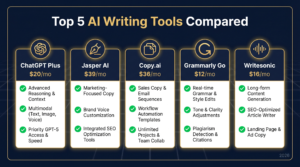
When selecting among these fifteen options, several factors merit careful consideration. First, consider your primary writing needs. Are you focused on marketing content, creative writing, technical documentation, or general productivity enhancement? Different tools excel in different domains, and selecting one aligned with your specific needs ensures maximum value.
Second, evaluate pricing against your budget and usage patterns. Some tools offer generous free tiers suitable for casual users, while others require paid subscriptions but provide superior capabilities. Calculate your likely monthly usage and compare cost-per-use across options.
Third, assess integration capabilities. If you already use specific platforms—Notion, Shopify, WordPress, or others—selecting a tool that integrates seamlessly with your existing workflow reduces friction and enhances productivity.
Fourth, consider the learning curve. Some tools require minimal training and can be productive immediately, while others benefit from deeper exploration to unlock advanced capabilities. Match the tool’s complexity to your willingness to invest in learning.
The Future of AI Writing Tools
The trajectory of AI writing technology suggests continued rapid advancement. Future iterations will likely offer even more sophisticated understanding of context, better handling of specialized domains, and improved ability to maintain consistency across extended pieces. The integration of AI writing tools with other business systems will deepen, creating increasingly seamless workflows.
However, it’s crucial to recognize that AI writing tools remain assistants rather than replacements for human writers. The most effective approach combines AI capabilities with human creativity, judgment, and expertise. AI handles routine generation and initial drafting, while humans provide direction, refinement, fact-checking, and the unique perspective that distinguishes exceptional writing.
Conclusion
The fifteen tools outlined in this guide represent the current pinnacle of AI writing technology, each offering distinct advantages for different use cases and user preferences. Whether you prioritize affordability, specialization, integration capabilities, or raw performance, options exist within this list to meet your specific requirements.
The democratization of advanced writing assistance through AI represents a genuine shift in how professionals approach content creation. Rather than viewing AI writing tools as threats to human creativity, the most successful professionals recognize them as force multipliers—technologies that amplify human capability and enable greater productivity without sacrificing quality or authenticity.
Your journey with AI writing tools should begin with clear identification of your specific needs, followed by systematic testing of options that address those needs. Most platforms offer free trials or generous free tiers, allowing risk-free exploration before financial commitment. Take advantage of these opportunities to discover which tools integrate most naturally into your workflow and produce outputs that resonate with your standards and objectives.
The future of writing belongs not to humans or machines, but to the productive collaboration between them. By thoughtfully selecting and implementing the right AI writing tools, you position yourself at the forefront of this collaborative revolution, capable of producing more content, more quickly, without compromising the quality and authenticity that distinguishes exceptional writing in an increasingly crowded digital landscape.